Thursday, February 10, 2011

A Moral Education or Amoral Education?

Jamie and I are currently in one of the most important steps of our baseline data collection process: observing teachers and classrooms to evaluate the quality of teaching.  Each teacher is being observed twice, as randomly as possible.  Yesterday, we were observing Religious and Moral Education (called RME) in JHS 2 (equivalent to 7/8th grade). 

Now, RME is a very interesting subject.  Given its name, one might think that it involves discussions of different religious and moral codes.   Not so much.  I think a more appropriate name for this course would be “Ghanaian Traditional Culture,” because students learn about the different codes of behavior and expectations of the various tribes in Ghana.

Below is a sample of the notes that the students took on the day’s subject:  Acestors.

Qualifications:
  1. Must be dead and have entered the spirit world. 
  2. Must not have died from the following diseases:
    1. Leprosy
    2. Epilepsy
  3. Must not have committed suicide.
  4. Good to have died as a war hero.
  5. Must have lived to a ripe old age (according to class consensus, that means 70)
  6. Must have married and have had children.
Importance:
  1. Ancestors are a link between the living and spirit worlds.
  2. Ancestors set good examples for the living.
  3. Ancestors are unseen guests at family gatherings.
  4. Ancestors are called upon to settle family disputes.
What I found most compelling from this class was not the emphasis on the spirit world, or the fact that leprosy/epilepsy/suicide were dealbreakers.  It was instead the fact that these students were effectively learning about their own culture in a class.

I usually think of culture as something that an individual experiences throughout his or her life, a collection of traditions, beliefs, and thought systems that are acquired with time.  It’s not something that one can learn in a classroom. Or is it? Maybe I’m wrong, and reaffirming culture in school helps to preserve it in the face of a changing society.  Either way, it raises the question:  how does traditional Ghanaian culture fit in with the modern lifestyles of Ghanaian youth?

It’s really a doozie of a question. There isn’t one answer – even among the teachers and students here, there is great variation among how much people adhere to traditional values, and which values are prioritized.  Some things are pretty standard: greeting is very important, deference to elders as well.  In fact, students and children as a whole don’t get a lot of respect.  It makes me wonder, if education is empowerment, and tradition dictates that children remain powerless, is my work to further quality education actually working to suppress Ghanaian culture? 

Saturday, February 5, 2011

Please, Please, Pay My Fees

I happen to be a proud product of the United States Public School System.  With the exception of a few years at a Montessori pre-school, my parents never had to pay for my primary education.  And all things considered, I think I turned out pretty well.

Here in Ghana, it’s rare to hear someone be proud of the public school system.  “Government schools,” as they are called, are universally considered as inferior to the nations numerous private schools. Why are government schools so much worse?  One thing to consider is class size – at many government schools, class sizes often reach 60 or 70 students, especially in rural areas.  However, the main reason usually cited for low quality of education is the teachers.  This is somewhat ironic, because the teachers at government schools are required to go a Teacher Training College, whereas private schools have the ability to hire whomever they wish. In theory, teachers at government schools are more prepared and qualified to teach.  But if you ask anyone in Ghana, they say those teachers are bad, because of a lack of oversight.  Private schools, which are often for-profit, monitor their teachers closely. But government schools lack both the infrastructure and the incentives to monitor their teachers, resulting in decreased effort.

This explains why many of the USAID programs, which work solely with government schools in Ghana, focus on school oversight and management.   It also explains why most parents will, if at all possible, send their kids to private schools, even if they struggle to pay for them.

At Manye in particular, the payment of school fees is one of the school’s major problems.  Current rates are as follows:  40 GHC/term for Nursery/KG; 50 GHC/term for Primary; 60 GHC/term for JHS.  Last term, inflows from school fees were only 65% of where they should have been.  Which means that this term, the school opened with almost 4,000 GHC worth of arrears owed to the school.

Manye is a non-profit school, because the proprietor is trying to provide education to the poorer families in the community.  This is great, because some of the families around here really can’t afford the 50 GHC/term for each kid. Unfortunately, there are many families who can afford the fees, but just don’t pay them because they can sort of get away with it.

It’s a very interesting situation, which manifests itself with management and teachers perpetually trying to convince students to bring money to the school.  I want to close this entry with a particularly poignant example. After practicing their alphabet and the two letter words that they already know, the KG class practiced the following song, complete with actions:

Please, please, pay my fees
Please, please pay my fees
I want to be a doctor
I want to be a pilot
Please, please, pay my fees
I want to go to America
America, America
I want to go to America
Please, please, pay my fees

Thursday, January 20, 2011

UnbeWEAVEable

Today, I got my hurr did. Like a Ghanaian.

It all started out back in September, when Jamie and I started talking about getting our hair braided at some point while we were here.  The kids like to play around with it, but I really wanted to try getting it done professionally, so that it would actually look good.

Irene, our local shopkeeper/best friend, is a woman of many talents: she also happens to be a hair-dresser.  She told me that if I wanted to get my hair done baako baako (one one -- aka not cornrows), then I would need to use a weave, because I simply do not have enough hair.  For those who don't know, "weave" is essentially fake hair that is woven into the real hair to increase volume or change color.

Now, the idea of using weave made me nervous  -- to start with, I had visions of myself with black hair, looking incredibly stupid. Second, I remembered Emily telling me how weave smells really bad (I hadn't noticed this...).  So the idea of getting our hair done became a joke that sort of faded into the background.

Until December 27. Jamie and I were at Makola (a huuuuuuge market in Accra) and happened to see some blonde weave. It was too expensive (8 GHC for a short one!), but it reignited the idea in our minds.  Then, a couple weeks later in Tema, we found a blonde and a reddish weave, each only 3 GHC. I promptly bought them, and set up an appointment with Irene to do my hair.

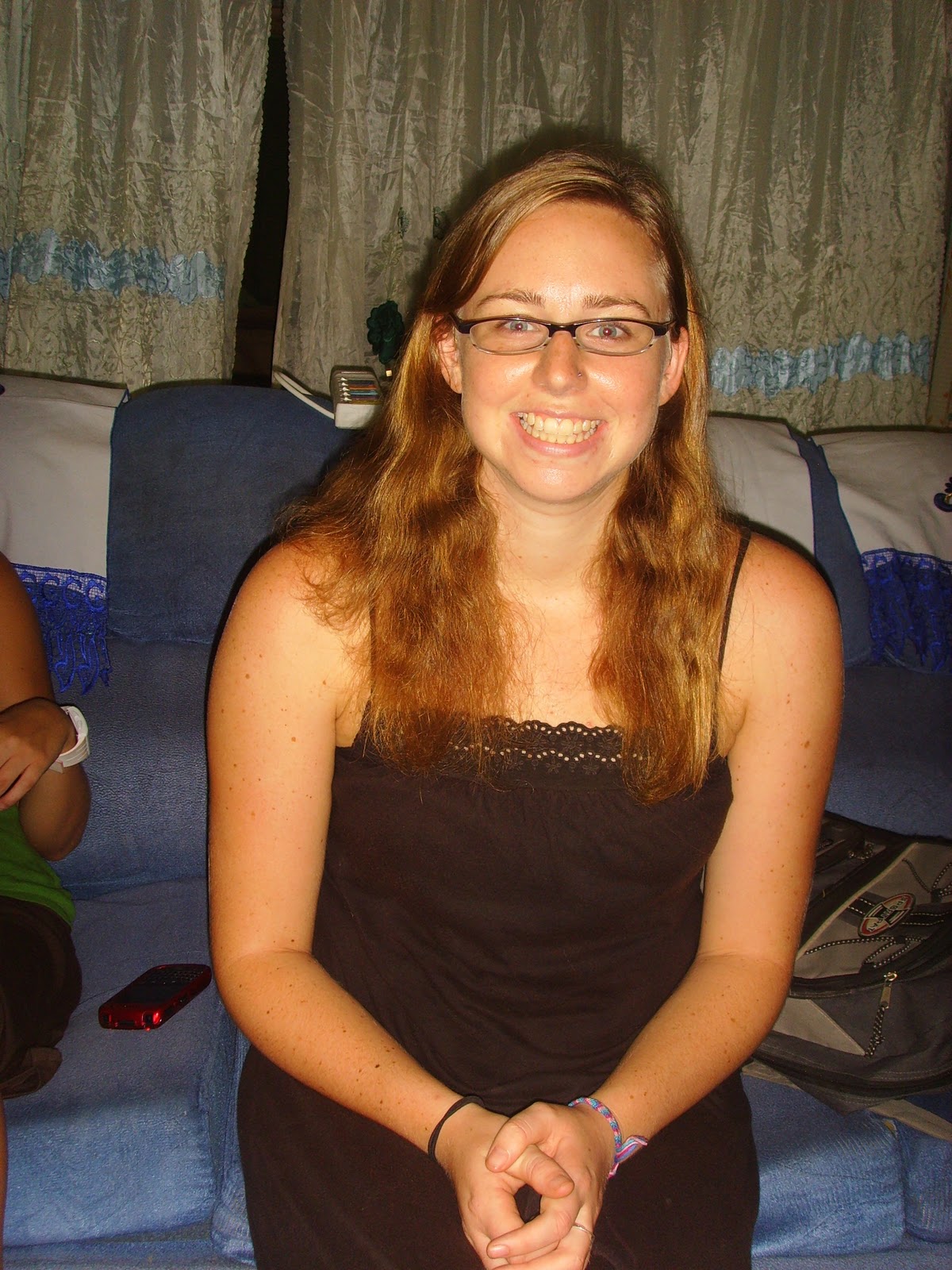
This morning, I left the house looking like this:


An hour later, Jamie came by to check on the progress... All I had were a few braids and a whole lot of messy hair:


Irene was speedy speedy speedy with her hands. Here we are already working in the second half of the weave that I bought.


After 2.5 hours, still not the finished product... at this point, I felt like a mermaid. The front ended up being more red than intended because we ran out of weave! And had to work in a extra red one with the remaining blonde.  Jamie is really excited for all the braids to be in:


The finished product! (after about 5 hours)

For the next 3 weeks, I don't have to wash my hair!! We'll see how long I make it before I cave and try to wash it...

Sunday, January 16, 2011

THE topic of the tropics: Malaria

When people heard I was coming to Ghana for a year, I got many many questions about malaria. Did I know if it was a concern here? [yes, I knew that yes, it is].  Had I gotten vaccinated for it? [no, there's no vaccination].  Was I going to die? [this is a slight exaggeration]. What could I do to protect against it? [bug spray, mosquito nets, anti-malarials]

Now the first two of those preventions methods were totally fine (and mandatory) for me.  And many thanks to the input of Emma and Mrs. Lochery for recommending a DEET-free and very pleasant smelling bug spray (well, lotion) that I love!

But I had a thing about anti-malarials.

I don't like medicine. I don't like taking pills. At all. Just ask my mother. I don't like it because I find it hard to remember and somewhat unpleasant.  And I also don't like it on a more philosophical scale because, most of the time, I'm never really sick enough to truly need medicine. And so I'd hate to use it now, and then when I'm older, frailer, with a weaker immune system, realize that I've been popping too many pills my whole life to get any effectiveness out of them. 


So for me, the decision about anti-malarials was a tough one. I had support on both sides:  my sister (among others) was convinced I would get  malaria and die if I didn't take them, whereas some former coworkers who had lived in similar climates with the same risks were confident that they weren't necessary. 


Long story short... I brought 3 months worth of anti-malarials with me. I took my Malarone religiously for my first month. Then the climate started to dry out, I stopped getting bit by as many mosquitos, and I decided I would rather save them for the rainy season (summer) when there were many more mosquitos around. 

And then I got malaria [we think]. And then I got better.

My experience with malaria was really quite mild.  I had a fever and was really achy and tired. And that's about it. I lounged around in bed for 2.5 days, took my medicine like a good patient, and recovered. But I never saw a doctor, never actually made sure that my blood tested positive for malaria. Here in Ghana, they don't really do that.  Because malaria is usually the more dangerous/painful of the fever-causing possibilities, they start treating for that immediately. And while it's not a perfect solution (especially to those of us who much prefer to know exactly what is wrong with us) it definitely worked out for the best. I didn't have to go anywhere to get looked at, which is fantastic, because all I wanted to do was lay down. 


I'm happy to say that I feel pretty fully recovered now (I first started feeling sick Tuesday night)... I just have a good excuse not to go jogging for a few more days =) 

Thursday, January 6, 2011

Time to Start the Donuts. I Mean... Trimester


Happy New Year everyone! Or, as they say in Twi, Afi hyia pa!

I’m going to open this blog with a very generalized sentence that should be taken with as little judgment as possible:  time functions very differently here in Ghana than it does in the States.

Yesterday (Tuesday  4 January) was the first day back for Manye.  In the States, the first day of school, either for the year, or for the term, is a pretty big deal. Kids pick out a special outfit, everyone gets to share stories about the break, no one has homework… that first day is filled with energy and excitement. Not so much here in Ghana. Out of the 200 or so students at the school, only about 25 showed up on the first day back. And several teachers weren’t here either. Some of the classes were combined, but not much was taught because 90% of students weren’t there.  This situation happened when I first arrived in September as well.  Attendance was minimal at first, but increased steadily over the first two weeks. By the Monday of the third week, attendance was up to normal.  

I assumed (or rather, hoped) that the beginning of the second term would be different than the beginning of a whole new school year.  Apparently, I was wrong.  In hindsight, it makes sense, because, as I said above, time functions differently here in Ghana than it does in the States.

Start times, deadlines, durations, appointments, travel times… all of these are much more flexible here.  If something is supposed to start at 9am, chances are it won’t start until 10 or 10:30. Similarly, if someone says it takes 30 minutes to get somewhere, plan on it taking about 2 hours. If someone says they will do something “tomorrow,” they’re probably actually thinking “I understand that you think this is important. I’ll do it when I get around to it.”  

For the most part, it’s pretty easy to adapt.  For myself, I would rather be early (on time) than be the one everyone is waiting for.   So you bring something with you (book, iPod, etc) for entertainment; more often however, Jamie and I use each other for entertainment. It’s something to joke about – being on “Ghana time” – and it seems pretty harmless, if inefficient.

But in many ways, it’s also a self-fulfilling prophecy.  People don’t want to be on time, because they’ll be the only ones.  And even if one is on time, most things don’t start then anyway. So those who are punctual are in fact punished because society caters to those who follow a more flexible time system.

How does this apply to education?  Manye’s school day officially starts at 8am, with the Morning Assembly.  JHS students have extra morning classes, and they’re also supposed to listen to a short radio program at 6:45am, so they’re supposed to come earlier.  But instead of telling students to be on time at either 6:45 or 8am, management tells students to come at 6:30 or 7. A few kids do this, and they have the chance to read or do homework before everyone else arrives.  But for the most part, kids show up when they finish their morning chores and can get to school.  

Another example: PTA meetings usually start at 3pm.  At my first one, there were only about 15 people here at 3pm, but by 4:30, when the meeting was in full swing, there were closer to 75.  In November, some parents managed to show up early, so management decided to start the meeting 30 minutes ahead of schedule. To most of us in the States, where scheduling is a way of life, this seems crazy and frustrating. And yea, sometimes it drives me crazy. 

But how can you blame kids for being late to school when many families don’t have clocks and even those who don’t usually don’t use them for alarms? Where there’s no cultural precedent for paying attention to specifics of time? You can’t. All you can do is set an example: show up on time and positively reinforce the behavior of those students (and parents) who do come on time.  Which is what Jamie and I try to do. And try to encourage the school to do as well. But it’s definitely an uphill battle. 

Monday, November 15, 2010

Tone Deaf

My musical debut occurred in Mrs. Lyttle’s 4th grade class, during our production of Dogs, Dogs, Dogs – a self-written parody of Andrew Lloyd Weber’s musical Cats. I played the inspired role of “Closet Girl,” a materialistic puppy, who along with her friends Snoodle, Anna Jean, and Tea Party were just four dogs in the group SCAT (no, at the time we were not aware of its meaning) looking to be adopted into a nice home.   At one point during rehearsals, we were recorded so that we could hear how it would sound to the audience (read: our parents).  When I heard myself belting out the lyrics, “Closet Girl’s my name/Without new clothes I wail/ I’m extremely trendy/From my head to my tail” (yes, I wrote them myself), I was shocked. When did my voice get so high and squeaky?  Why didn’t it match the pitch of the piano in the background?  

Since that fateful day in 1997, I have been well aware that while I love music, it is best if I don’t express this love by singing a capella in public.  When people ask me if I can sing, my reply is either “not well” or “very badly”.  Luckily, no one in my family is musically inclined (anyone who’s stood in front of us in church can attest to that), so I’ve never been too self-conscious about it.  But, imagine my dismay to learn that my coworker in Ghana, the girl who I would be living with for at least the first 4 months of my time here, was not only in Gospel Choir and an a capella group… but she also placed 3rd in Dartmouth Idol 2010!! No joke, I was nervous. I feared that she would be mortally offended by my off-key renditions of Iyaz, Beyonce, even Ke$ha. THANK GOD – she’s not. At least, she hasn’t said anything to me yet…

But back to my point: I’ve found kindred spirits in Ghana. People here LOVE music, just like me! And, just like me, the ability to sing in key doesn’t really seem to matter! People here belt it out no matter how good they sound.  For the most part, it’s refreshing not to feel self-conscious. Occasionally though, I'll admit that I wish those who are tonally challenged (like me) were a tad more considerate of how they sound…  

Even though my past couple entries have been of a more serious and philosophical nature, I promise that life here is not all work and thinking about poverty.  It’s really fun too!! A large part of this is the presence of music everywhere: at the school’s morning and afternoon assemblies, at all the churches, on the radios of the local stores, and in our home.  Jamie and I have embraced the local genre, called HipLife, and have spent hours looking up lyrics, dancing around our room, and uploading songs from friends’ flashdrives.  We’ve also been to 3 (FREE!) concerts in the past 2 months.  Below are some of our favorites from what we’ve been listening to:

1) Sarkodie. He’s a Ghanaian rapper, who became famous last year when he won an award for being the “fastest rapper in Ghana”.  The first song of his we liked was called “Babe,” but we’ve recently gotten into “Borga”, shown below:


2) R2Bees. Apparently this groups name is an acronym for “Refuse to Be Broke”.  Given the popularity of their song “Kiss Your Hand” on the radio, I’d have to guess that they’re doing okay.  We really like it, and I’m posting it here because it’s a good example of the HipLife sound.  Enjoy!


3) Castro ft. Asamoah Gyan.  This song isn’t necessarily one of our favorites, but I think it’s worth including.  For those who watched Ghana in the World Cup quarterfinals, you might remember the missed penalty kick by Asamoah Gyan that cost Ghana the match.  Well, if that career fails him, he can always fall back on his budding music career… or not. Despite being hated on for spending time recording a music video when he should have apparently been practicing his penalty kicks, this song (African Girls – its kinda like a Ghanaian Mambe #5) gets a lot of airtime, and I personally like it a lot:


It’s not only homegrown Ghanaian music that is popular here.  The radios play a lot of Nigerian music (like PSquare), American hiphop (and even some American country!), and of course, Jamaican reggae.  Bob Marley is popular, no surprise there, but Jamie and I are slightly obsessed with the various remixes that we hear of this song: “Hold You” by Gyptian. She knew it from this past summer in the States, but as I didn’t hear it until after my arrival, it will forever remind me of Ghana:


So. That’s it. Well, that’s 4 samples of the 50 or so songs that we’ve become familiar with. But one thing that we don’t have access to is new American releases. So, for those of you who can, please comment or shoot me an email and let me know what’s playing on the radio, in the frat basements, etc. Iyaz’s “Solo” is getting way to much airtime on our speakers.  =)

Thursday, November 11, 2010

Unintended Legacies


After almost two months of being “alone on the ground,” the President/Country Director of WPE (Ben Schwartz, Dartmouth ’06) arrived for an indefinite stay in Ghana. For a little background, WPE was founded as a result of Ben’s experience here at Manye. During his Junior Winter, he worked through a volunteer organization and happened to be placed at Manye Academy, a small school of about 30 students.  Ben was so affected by his time in Community 25 that he applied for (and received) a Lombard Grant to come back after graduation, during which time he taught in the primary school, and tried to help Mr Kabutey make positive changes to improve the quality of education.  This still wasn’t enough, so upon his return, he worked with some other Dartmouth students who also volunteered here at Manye to set up World Partners in Education. Since then, WPE has sent more than 10 volunteers to Manye, in groups of three or four, to work on projects with the kids. 

Fast forward to September, 2010 when Catherine and Jamie arrive to serve as WPE’s first set of Educational Consultants at Manye. As consultants, we’re supposed to be separate from the school – we’re here to empower the current stakeholders, not do their jobs for them. Another important part of our work here is working with WPE’s Monitoring & Evaluation Committee for data collection, so that we can actually make sure that our projects and interventions are doing some good. Unlike the volunteers, who immediately jumped into doing Creative Arts projects with students and tutoring those who had fallen behind, so as not to waste a day of their 2 months, Jamie and I were instructed to take things slow, to focus on building relationships with all stakeholders, not to jump into projects just because we’re touched by the hardships the kids here face.  Along these lines, it was also expressed to us that it’s not our job to shower the community (or the kids) with presents; we need to navigate power dynamics, and spending lots of money could be a challenge to that. From my (limited) experience with international development, this is a pretty standard policy for NGOs, and since my income for the year is zilch, I had absolutely no problem adopting this philosophy.

But here’s where things got tricky. Because Jamie and I were the first ‘consultants,’  we were also the first obrunis at Manye who weren’t there to spend all their time playing with kids, buying them biscuits, or showing movies on Friday afternoons. The first couple weeks we were there, it was unbelievable (to us) how many of the younger students, who didn’t know our names, would come up to us and say, “Madam, buy me biscuits”.  One day, when I was wearing a headband to go jogging, I was shocked when a girl who happened to be a favorite of the summer volunteers, looked at me with a straight face and said, “Madam, when you leave, you give me your headband.” My immediate reaction was “Hell no. Not when you ask like that.”  But no worries – I didn’t blurt that out. I managed instead something much more neutral and noncommittal, like, “We’ll see”. 

Because is it really their fault? What else could they expect, when for the past couple years, groups of young, enthusiastic obrunis come over for two months at a time. And what are they here for? They’re here to experience Africa, to learn about international development, to make a difference in the lives of kids. And I have no doubt that they do. Because for every few of the annoying “Madam, buy me biscuits,” I encountered a “Madam, will you send this letter to Madam _____?” And on opening these letters to scan and email them to former volunteers, I see notes of labored English talking about how they are working hard in school and how they are reading better and how they miss Madam ____.  So I’m not condemning volunteer programs; I really do believe that individual relationships can make a difference in the life of a student, and I really do think that the kids here deserve to be treated special every once in a while.  And to be honest, part of me wants do be the one to do that. I want to connect with a child, to develop a close relationship, and know that I’ve made a profound difference in his or her life.  I mean, let’s be real… who wouldn’t want that?

But what I’ve realized here is that the quest for those relationships, and the more tangible effects of those relationships, have side effects. The intention is to make the kids happy, to open their eyes to the potential of a brighter future. To show them what life could be like if they study hard, do well in school, and stay out of trouble.  But the unintentional legacy is the common belief that every obruni (especially us younger ones) is here for the same reason.  And even if most are here trying to create a brighter future, we’re not all trying to do it by buying presents or even teaching kids how to read.